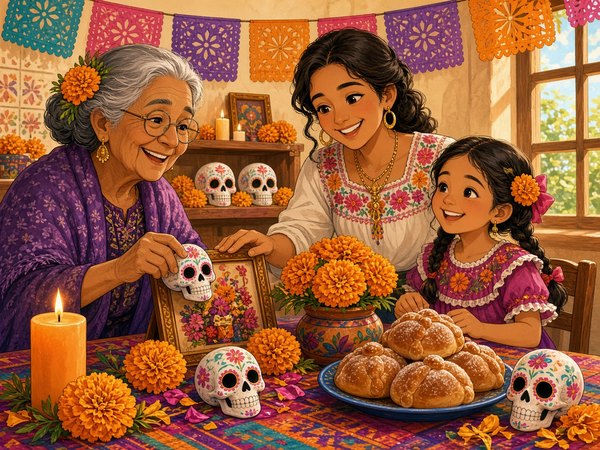
While much of Europe spends the first days of November quietly visiting cemeteries, Mexico celebrates the same moment in a burst of colour. Día de los Muertos, the Day of the Dead, takes place on 1 and 2 November and is one of the most recognisable festivals in the world. Behind the bright marigolds and painted skulls lies a tradition that is less about fear and more about love, memory and family.
The roots of the festival reach back to Indigenous cultures such as the Aztecs, who honoured their ancestors with rituals long before Spanish colonisers arrived. Over the centuries these customs blended with the Catholic feasts of All Saints’ Day and All Souls’ Day. The result is a celebration with a simple and comforting idea at its heart: for a short time each year, the souls of the departed return to visit the living.
What belongs on an ofrenda?
The centre of the celebration is the ofrenda, a home altar built in honour of loved ones who have passed away. Families place photos of the deceased on it, surrounded by candles that light the way home. Bright orange cempasúchil flowers, a type of marigold, are scattered as petals or arranged in vases, because their strong colour and scent are said to guide the spirits.
Food plays a big role. There is usually a glass of water for the long journey, favourite dishes of the person being remembered and pan de muerto, a soft sweet bread decorated with bone-shaped strips of dough. Small sugar skulls, called calaveras, are often decorated with colourful icing and sometimes carry the names of the dead or even of living friends as a friendly joke. Cut-paper banners known as papel picado flutter above the altar and represent the fragile line between life and death.
A festival full of life
In many towns the celebration moves outside. Families clean and decorate graves, bring music and food and spend the night in cemeteries, sharing stories about the people they miss. In cities like Mexico City and Oaxaca, parades with giant puppets and painted faces draw visitors from around the world. The elegant skeleton lady La Catrina, first drawn by the artist José Guadalupe Posada more than a century ago, has become a symbol of the festival and a gentle reminder that death treats everyone equally.
In 2008 UNESCO added the Indigenous festivity dedicated to the dead to its list of the Intangible Cultural Heritage of Humanity. Films and travel have since made the imagery famous far beyond Mexico, sometimes at the risk of turning it into a costume theme. Yet for Mexican families it remains a personal and meaningful time.
Perhaps that is the most beautiful lesson of Día de los Muertos: remembering does not have to be sad. Lighting a candle, cooking a loved one’s favourite meal or simply telling their story at the dinner table keeps them close. Whatever your own traditions are this November, that idea is easy to share.