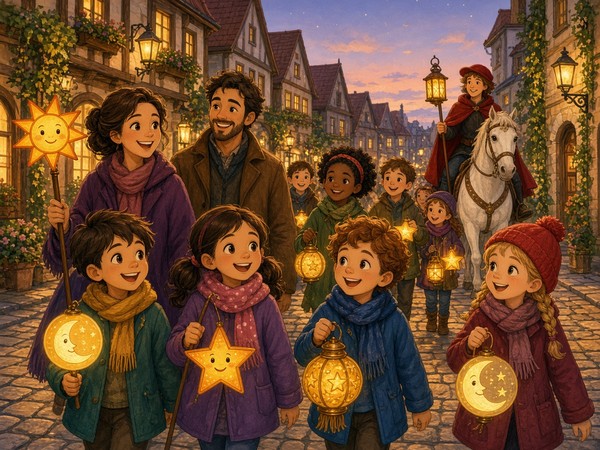
Every year on 11 November, as the days grow noticeably shorter, small points of light start moving through streets in Germany, Austria, the Netherlands, parts of Switzerland and Belgium, and many other places. Children carry glowing paper lanterns, sing old songs and follow a rider in a red cloak. St. Martin’s Day is one of the gentlest traditions of the autumn calendar, and it has stayed remarkably popular in an age of screens and busy schedules.
The custom goes back to Martin of Tours, a Roman soldier of the fourth century who later became a bishop. The best-known story about him is simple: on a freezing evening he met a poor man at the city gate, drew his sword and cut his military cloak in two so the stranger would not freeze. That single act of sharing is the heart of the festival, and it is why the rider on horseback, often in a red cloak, leads so many processions today.
Why do children walk with lanterns on St. Martin’s Day?
The lanterns have several layers of meaning. Historically, 11 November marked a turning point in the farming year: the harvest was in, workers were paid, and the long, dark part of the year began. Lights carried through the dark became a natural symbol of warmth and hope. For the Christian tradition, the lanterns also stand for the good deeds that brighten the world, just as Martin’s shared cloak did.
For children, of course, the most exciting part is often making the lantern. In kindergartens and primary schools, the weeks before the festival are filled with paper, glue, tissue and cardboard. Suns, moons, stars, owls and hedgehogs are favourite shapes. Many families now use small battery-powered LED sticks instead of real candles, which is safer for young children.
Songs, bonfires and a sweet bread
The processions are usually accompanied by traditional songs that many adults still remember word for word from their own childhood. Some towns end the walk with a Martin’s bonfire, a short re-enactment of the cloak scene, or a small gathering with warm drinks. In many regions, children receive a sweet yeast bread shaped like a little man, known under different local names, or they go from door to door singing in exchange for treats, a custom that existed long before Halloween became fashionable in Europe.
Food plays a role for adults too. The roast goose is closely tied to the day, partly because geese were traditionally ready for the table around this time, and partly because of a legend that Martin tried to hide in a goose pen to avoid being made a bishop, only to be given away by the noisy birds.
A small tradition with a modern message
What makes St. Martin’s Day feel relevant is how little it asks of people. There is no expensive shopping list and no pressure to impress anyone. The idea is to notice someone who is cold, in any sense of the word, and share a little of what you have. Many schools and parishes connect the processions with collections for food banks, winter clothing drives or donations for homeless shelters.
If you have never joined a lantern walk, it is worth looking up local dates; many communities hold them on or around 11 November, often in the early evening so even the youngest children can take part. It is a quiet, cheerful way to welcome the dark season and to remember that one shared cloak can still be a powerful idea.